How to Weigh a Horse Without a Scale
A step-by-step guide to estimating your horse's weight with a tape measure, the girth and length formula, body condition scoring and good record keeping.
Knowing roughly what your horse weighs makes almost every management decision easier. Hay rations, trailer loading limits and spotting quiet weight loss over the winter all start with a number. Visual estimates are often off by 100 lb or more, especially under a winter coat. Yet very few owners have access to a livestock scale. The good news is that a soft tape, a helper and five minutes give you an estimate that is close enough for day-to-day care, and far better than guessing by eye.
What you need
- A soft tape measure at least 100 in (about 250 cm) long. A tailor's or fiberglass builder's tape works well; a metal tape does not.
- A helper to hold the horse and the other end of the tape.
- Firm, level ground, such as a concrete aisle or a flat patch of yard.
- A notebook or phone to record the date, the measurements and any notes.
Choose a calm time. Measuring right after a big hay meal or a long drink can add a few pounds of gut fill, so many owners measure before the morning feed.
Step 1: Stand the horse square
Ask your helper to stand the horse with its weight evenly on all four legs, the front legs side by side and the head at a natural height. A horse resting one hind leg or stretching its neck down to graze shifts its shape and changes the numbers. Give the horse a moment to relax so it is not bracing or holding its breath.
Step 2: Measure the heart girth
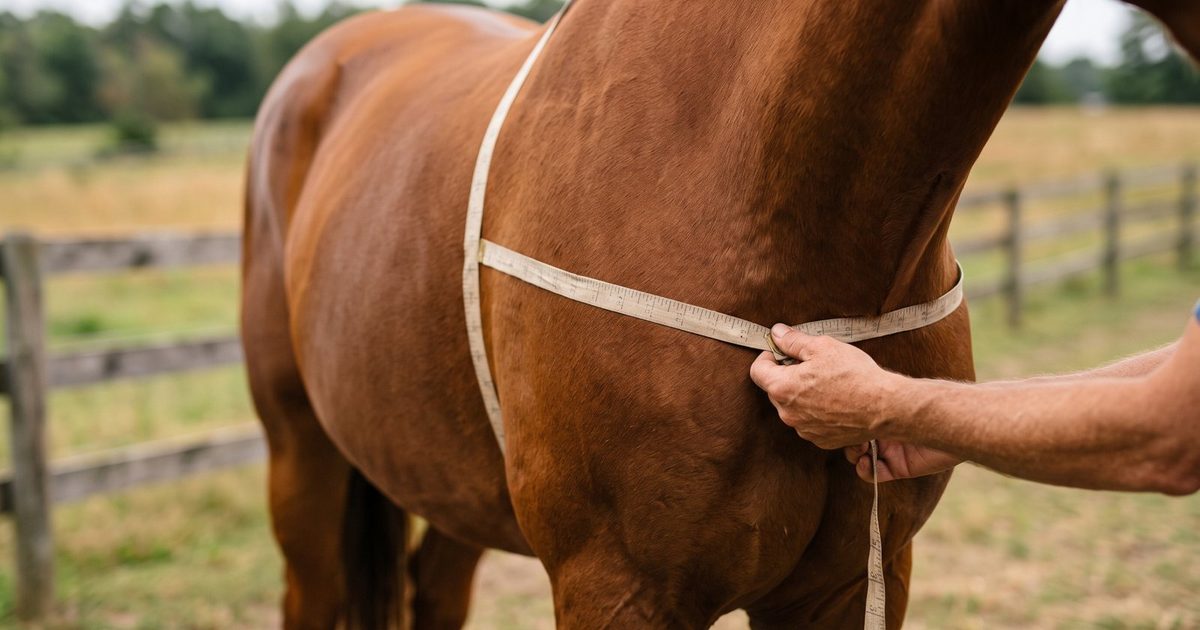
The heart girth is the circumference of the barrel just behind the elbows. Place the end of the tape over the withers, slightly behind the highest point, and pass it down behind the elbow, under the belly where the girth of a saddle would sit, and back up the other side. Keep the tape at a right angle to the ground rather than slanting it back. Pull it snug enough to flatten the hair but not so tight it digs in. Take the reading as the horse breathes out.
Repeat the measurement two or three times. If the readings differ by more than about an inch, check your tape position and try again.
Step 3: Measure the body length
Body length is measured from the point of the shoulder (the bony prominence at the front of the shoulder, where the neck meets the chest) straight back to the point of the buttock (the rearmost point of the hindquarters, beside the tail). Your helper holds one end while you run the tape along the side of the horse, keeping it as level and straight as possible. Again, take two or three readings.
Step 4: Apply the formula
With both measurements in inches, the widely used formula for adult horses is:
Weight (lb) = heart girth × heart girth × body length ÷ 330
Here is a complete example. Suppose your horse measures 70 in around the girth and 66 in in length:
- 70 × 70 = 4,900
- 4,900 × 66 = 323,400
- 323,400 ÷ 330 = 980 lb (about 445 kg)
For young horses, smaller divisors are often used: around 301 for yearlings and 280 for weanlings. If you measure in centimeters, either convert to inches (divide by 2.54) or use the metric version, which is approximately girth² × length ÷ 11,900 for a result in kilograms. Our horse weight calculator does all of this for you and gives a realistic range.
How accurate is it?
For an average adult riding horse, a careful tape and formula estimate often lands within about 5 to 10% of a scale weight. That means a 1,000 lb horse might read anywhere from roughly 900 to 1,100 lb. That is plenty for planning hay and noticing trends, but it is not a precise measurement. Accuracy is lower for drafts, miniature horses and small ponies, very fit or very heavy horses, pregnant mares and growing youngsters.
Common mistakes that skew the result
- Measuring girth too far back, over the belly instead of just behind the elbow
- Letting the tape slant or twist along the body length
- Pulling the tape tighter on some days than others
- Measuring once on concrete and once on soft, uneven ground
- Mixing up inches and centimeters in the formula
Combine weight with body condition scoring
Weight alone does not tell you whether a horse is fat or thin, since a big-boned, muscled horse can be heavy and lean at the same time. That is why many owners pair tape measurements with a body condition score. The 1 to 9 body condition scoring system, widely used in the US and UK, scores horses from 1 (very thin) to 9 (extremely fat) by feeling and looking at six areas: the neck, withers, shoulder, ribs, loin and tailhead. Most riding horses do well around 5, where ribs are not visible but can be felt easily.
Run your hands over these areas every time you measure. Under a winter coat, feeling is far more reliable than looking. Note the score next to the weight in your record.
Build a simple tracking routine
The real value of tape weighing is in the trend. A single reading might be off by 50 lb, but five readings that each drop a little tell a clear story. A practical routine looks like this:
- Measure every two to four weeks, and more often during a diet change or the first months of winter.
- Use the same tape, the same helper if possible, the same spot and the same time of day.
- Record girth, length, calculated weight and body condition score in one place.
- Look at the last three to five entries before making a decision, not just the latest one.
For example, a 16-year-old gelding measured at 1,040 lb in October, 1,020 lb in November and 990 lb in December has lost about 5% of his weight in two months. That is worth acting on: review his hay intake with the hay calculator, check his teeth have been examined recently, and talk to your vet about whether anything else is going on.
When a real scale matters
There are times when an estimate is not good enough. If your vet needs an accurate weight, for instance before prescribing medication or anesthesia, they may weigh the horse on a scale at the clinic or use their own judgment. Never use a tape estimate to work out medication doses yourself. Many equine hospitals, feed stores, agricultural shows and some large boarding barns have walk-on scales, and a weigh-in once or twice a year is a great way to check how well your tape estimates match reality for your particular horse. If the scale says 1,060 lb and your tape said 1,000 lb, your tape reads about 6% low for that horse.
FAQ
Are commercial weight tapes accurate?
Weight tapes printed with pounds or kilograms use heart girth only, so they assume an average body length. They are convenient for tracking trends but tend to be less accurate than the girth and length formula for long or short horses.
How often should I weigh my horse?
Every two to four weeks is a good habit for most horses. Weigh more often for seniors in winter, horses changing workload, or any horse whose diet has recently changed.
Can I weigh a foal this way?
You can get a rough figure using a smaller divisor, but foals grow so fast and vary so much that error is large. Ask your vet how they want growth monitored.
My horse's weight dropped suddenly. What should I do?
Remeasure carefully first. If the drop is real, contact your veterinarian. Unexplained weight loss can have many causes, from dental problems to illness, and needs a professional assessment.